

[Aug 13, 2026] Pass Veeam VMCE_v12 Exam Info and Free Practice Test
VMCE_v12 Exam Dumps PDF Updated Dump from DumpsActual Guaranteed Success
Veeam VMCE_v12 Exam Syllabus Topics:
| Topic | Details |
|---|---|
| Topic 1 |
|
| Topic 2 |
|
| Topic 3 |
|
| Topic 4 |
|
| Topic 5 |
|
| Topic 6 |
|
| Topic 7 |
|
| Topic 8 |
|
| Topic 9 |
|
| Topic 10 |
|
| Topic 11 |
|
| Topic 12 |
|
| Topic 13 |
|
NEW QUESTION # 92
A Scale-out Backup Repository with one local extent has been configured as follows.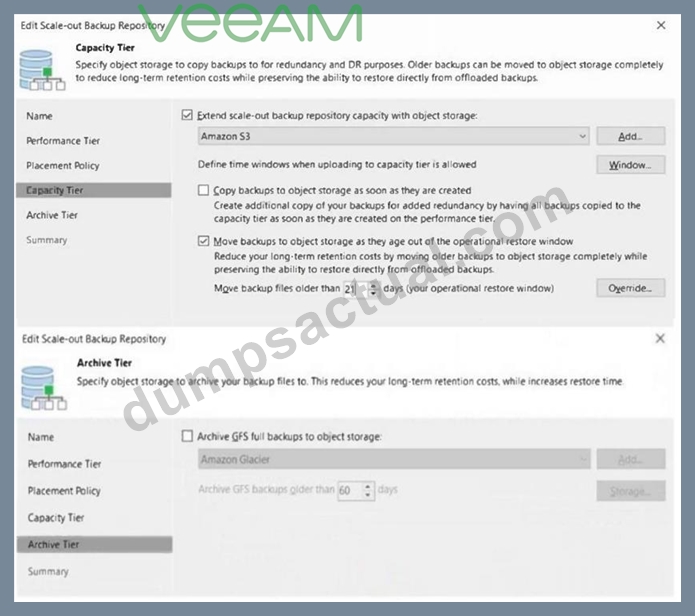
A daily VMware backup job retention is 31 days, keeping weekly GFS full backups for 14 weeks.
It is Mar, 20. A file from a backup that occurred the week of Jan, 1 must be recovered. Where is the data?
- A. The archive tier
- B. The performance tier
- C. The capacity tier
- D. The data is no longer in the Scale-out Backup Repository
Answer: C
Explanation:
Based on the configuration shown in the image, backups older than 21 days are moved to the capacity tier. Since the VMware backup job retention is set for 31 days and keeps weekly GFS full backups for 14 weeks, the backup from the week of January 1st is older than 21 days but within the 14-week GFS retention policy. Therefore, as of March 20, the backup data you need to recover would be in the capacity tier, not on the local performance tier, because it has been offloaded to the object storage configured as the capacity tier to reduce long-term retention costs.
NEW QUESTION # 93
Veeam Backup & Replication supports which of the following NetApp Data ONTAP modes?
- A. 7-mode only
- B. Only NatApp EDGE in 7-Mode
- C. Both 7-mode and Clustered Data ONTAP
- D. Clustered Data ONTAP only
Answer: C
NEW QUESTION # 94
A planned failover of three VMs has just completed successfully, starting the VMs at the disaster recovery location. What next actions are available for the failover plan?
- A. Undo, Start, Copy, Delete
- B. Cancel, Start, Edit, Delete
- C. Undo, Start, Edit, Delete
- D. Cancel, Start, Copy, Delete
Answer: C
Explanation:
Explanation
https://helpcenter.veeam.com/archive/backup/110/vsphere/failover_plan_undo.html According to the Veeam Backup & Replication user guide1, a failover plan is a set of rules that defines how VMs must be failed over to their replicas1. You can create and run failover plans for regular replicas and CDP replicas1.
After you run a failover plan, you can perform the following actions on it2:
Undo - reverts VMs in the failover plan back to their original state at the production site2.
Start - runs the failover plan again if you need to repeat the failover operation for some reason2.
Edit - modifies the settings of the failover plan, such as adding or removing VMs, changing their order or time delay1.
Delete - removes the failover plan from Veeam Backup & Replication. This does not affect the VM replicas that are used by the plan1.
NEW QUESTION # 95
What is a Recovery Point Objective (RPO) in regards to disaster recovery?
- A. The maximum amount of time it takes to restore a system
- B. The number of recovery points created during the backup process
- C. The acceptable data loss measured in time that can be tolerated
- D. The total cost associated with recovering a system
Answer: C
Explanation:
In the context of disaster recovery, the Recovery Point Objective (RPO) is best defined by option B: The acceptable data loss measured in time that can be tolerated. RPO is a critical metric in disaster recovery and business continuity planning that specifies the maximum amount of data (measured in time) that an organization can afford to lose in the event of a disaster or system failure. It effectively sets the limit for how frequently data backups or replications should occur. For instance, an RPO of 4 hours means that the organization must be able to recover data from no more than 4 hours prior to the disaster, implying that backup or replication operations should occur at least every 4 hours. Establishing an RPO is essential for developing an effective data protection strategy, as it guides the choice of backup methodologies and technologies to meet the organization's tolerance for data loss.
NEW QUESTION # 96
Veeam Backup & Replication is currently configured to back up different workloads: Windows virtual machines on VMware vSphere and Linux virtual machines on Microsoft Hyper-V. A secondary copy of all the backups including transaction logs must be created. Which backup copy job configuration is correct?
- A. Two immediate copy backup copy jobs
- B. A single periodic copy backup copy job
- C. Two periodic copy backup copy jobs
- D. A single immediate copy backup copy job
Answer: A
Explanation:
2 Backup Copy Jobs in Immediate mode. Mixing vSphere backup and hyper-v is not supported, Periodic copy doesnt support log backups.
NEW QUESTION # 97
Which two ways can a Microsoft SQL database be backed up to a Veeam repository using tools native to Microsoft SQL? (Choose two.)
- A. Use Veeam Agent for Microsoft SQL.
- B. Use application-aware processing for Microsoft SQL.
- C. Use Enterprise Manager s self-service backup capabilities.
- D. Use Veeam Plug-in for Microsoft SQL.
Answer: B,D
Explanation:
Use the Veeam Plug-in for Microsoft SQL Server
This installs directly into SQL Server Management Studio and leverages SQL's own backup engine (full, differential, log, copy-only, etc.) to write backups straight to your Veeam repositories.
Use application-aware processing for Microsoft SQL
In a standard VM backup job you enable "application-aware processing," which uses Microsoft's VSS writer for SQL Server to quiesce the databases and capture a transactionally-consistent image - those VSS-based backups then land in your Veeam repository.
NEW QUESTION # 98
A Veeam administrator has been tasked to create a backup that will automatically make a copy of data on a different media type, while also being off site, without creating additional backup or backup copy jobs. The administrator has determined that a Scale-out Backup Repository can be used as part of the solution. How can this be accomplished?
- A. Add a capacity tier to the Scale-out Backup Repository and enable the "Move" option.
- B. Add an archive tier to the Scale-out Backup Repository and enable "GFS Tiering".
- C. Add a capacity tier to the Scale-out Backup Repository and enable the "Copy" option.
- D. Add an archive tier to the Scale-out Backup Repository and enable the "Copy" option.
Answer: C
Explanation:
Explanation
https://helpcenter.veeam.com/docs/backup/vsphere/capacity_tier_copy.html?ver=120
NEW QUESTION # 99
A Veeam administrator wants to diagnose known issues in the configuration and performance of backup infrastructure without involving Veeam Technical Support.
What feature of Veeam One should the administrator use?
- A. Log Shipping Servers
- B. Business View
- C. Best Practices Analyzer
- D. Intelligent Diagnostics
Answer: D
Explanation:
For diagnosing known issues in the configuration and performance of the backup infrastructure without the direct involvement of Veeam Technical Support, the administrator should utilize A: Intelligent Diagnostics in Veeam One. Intelligent Diagnostics is a feature designed to proactively detect known issues within the Veeam backup infrastructure by analyzing the system's event logs, performance data, and configurations. It uses predefined patterns and rules derived from common issues identified by Veeam Support to provide early warnings and suggest corrective actions. This self-service approach enables administrators to address potential problems before they impact operations, enhancing the reliability and efficiency of the backup infrastructure.
NEW QUESTION # 100
A backup administrator is called in to review a new Veeam deployment created by a coworker. The backup administrator takes the following notes:
* 12 backup jobs
* 1 SOBR configured with AWS S3 Performance Tier
* 1 Repository configured on Hardened Immutable Repository
The administrator also notes that six jobs are configured to use the SOBR and six jobs are configured to use the Hardened Immutable Repository.
What should the backup administrator report to the other coworker regarding the 3-2-1 backup strategy?
- A. This needs the Hardened Immutable Repository added to the capacity tier.
- B. This meets the 3-2-1 best practices requirements.
- C. This only has 1 copy of the backup data.
- D. This will save costs with the Archive Tier in the SOBR.
Answer: C
Explanation:
The 3-2-1 backup strategy is a best practice that suggests having three total copies of your data, two of which are local but on different devices or media, and one copy offsite. In the described scenario, although there is an offsite component (SOBR with AWS S3 Performance Tier), and a local hardened immutable repository, there is no indication of a second local copy on a different device or media. This means that there is only one local copy of the backup data and one offsite copy. Therefore, the setup does not meet the 3-2-1 best practices requirement, which would involve having at least one more local copy on different media or device.
NEW QUESTION # 101
Hourly backup jobs are configured to local repositories. Daily backups must be sent from Site B to the repository on Site A.
The connection between the two sites does not allow a direct backup to complete within the backup window.
Impact on the source VMs at Site B should be minimized.
Which type of job and Veeam components should be used to provide the necessary protection?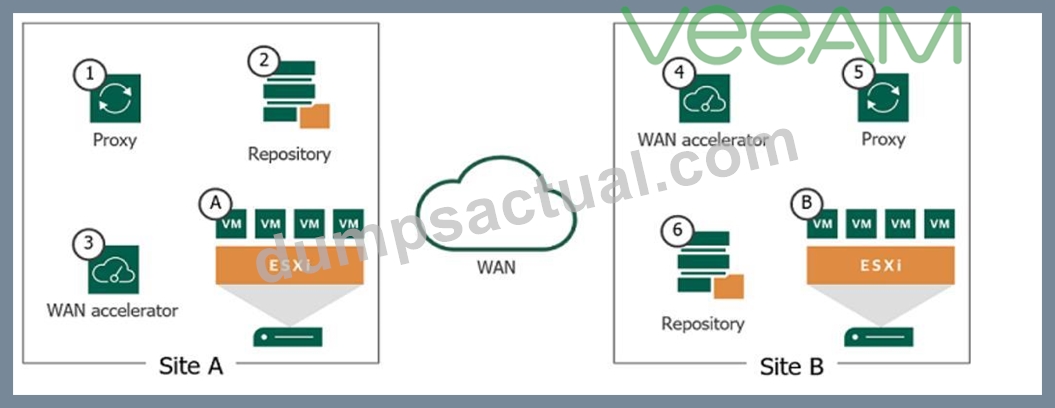
- A. A backup job and components 5 - 2
- B. A backup copy job and components 6 - 4 -> 3 + 2
- C. A backup job and components 5 -> 4 -> 3 -> 2
- D. A backup copy job and components 6 -> 5 -> 4 - 3 -> 1 -> 2
Answer: D
NEW QUESTION # 102
A company is running nightly backups to satisfy their 24-hour RPO. There are two critical applications that cannot be offline for more than four hours with no more than an hour of data loss.
How can this be accomplished?
- A. Hourly virtual machine replication job
- B. Hardened repository with immutability
- C. Local Scale-out Backup Repository with Amazon Web Services object storage
- D. Hourly file copy job
Answer: A
Explanation:
Using an hourly virtual machine replication job ensures that the critical applications are continuously available and can be recovered with minimal downtime and data loss, meeting the strict RPO and RTO requirements.
NEW QUESTION # 103
An engineer has a NAS file share to protect.
What preliminary step must be taken to create a NAS backup job?
- A. Register the file server under Storage Infrastructure in the VBR console
- B. Define file exclusions in the job
- C. Add a File Share under Inventory and choose NAS Filer
- D. Add a Managed Server with the IP address of the NAS Filer
Answer: C
Explanation:
Before creating a NAS backup job, an engineer must add the NAS file share to the Veeam Backup & Replication (VBR) console under the Inventory section. This involves specifying the NAS Filer and the particular file share to be protected. This step allows Veeam to recognize the file share as a valid source for backup operations.
NEW QUESTION # 104
For Veeam agent backup jobs, what feature is only available with Veeam Agent for Microsoft Windows?
- A. Application-aware processing of PostgreSQL
- B. Backup from storage snapshots
- C. File-level backup
- D. Volume backup
Answer: B
NEW QUESTION # 105
Which Veeam replication failover function ensures that changes made during a failover are copied to the original production VM?
- A. Permanent failover
- B. Fallback
- C. Undo failover
- D. Undo fallback
Answer: B
Explanation:
In Veeam replication, the function that ensures changes made during a failover are copied back to the original production VM is Fallback. This process involves reversing the replication direction after a failover, ensuring that any changes made while running on the replica are synchronized back to the original VM.References:Veeam Backup & Replication User Guide, Veeam Replication Fallback Guide
NEW QUESTION # 106
A Veeam engineer creates a Scale-Out Backup Repository (SOBR) that uses AWS S3 as the Performance Tier. The backup job is configured to "Keep monthly full backups for: 12 months". The engineer wants the backups to move to Glacier after 90 days.
What should the engineer do first to achieve this goal?
- A. Add an Archive Tier with the appropriate Bucket from S3
- B. Add AWS S3as a Capacity Tier before theycan use Glacier
- C. Reconfigure the SOBR to use block storage as the Performance Tier
- D. Create a Vault in S3 Glacier
Answer: B
Explanation:
In Veeam Backup & Replication, to utilize AWS S3 Glacier for long-term storage, the AWS S3 must first be added as a Capacity Tier within the Scale-Out Backup Repository (SOBR). This step is necessary before backups can be moved to Glacier. Once S3 is established as the Capacity Tier, the policies for moving backups to Glacier can be configured based on the retention requirements (in this case, after 90 days). This approach ensures that the monthly full backups are initially stored in S3 and thenoffloaded to Glacier for cost-effective long-term retention.References:
* Veeam Documentation: Scale-Out Backup Repository
* Veeam Help Center: AWS S3 as Capacity Tier and Archive Tier Configuration
NEW QUESTION # 107
A power outage on Site A is expected during the night. The disaster recovery strategy has been implemented (see diagram). What is the correct way to start replicated VMs on Site B to minimize data loss?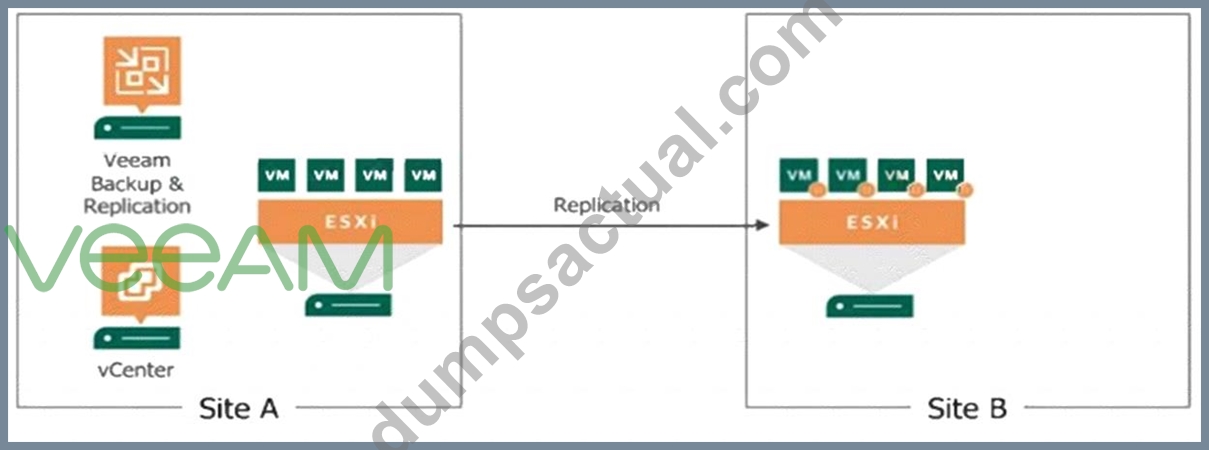
- A. Execute "Failover plan".
- B. Execute "Permanent failover" from vCenter.
- C. Power on VMs manually through vCenter.
- D. Execute "Planned failover".
Answer: D
Explanation:
A planned failover is a process that allows for the seamless switching from the original VMs at Site A to their replicas at Site B with no data loss. This is the correct course of action when a power outage is expected, as it is a controlled process that ensures that all data is synchronized before the switch is made. This action minimizes data loss and ensures that the VMs on Site B are up-to-date.References:
* Veeam Backup & Replication User Guide: Failover and Failback
* Veeam Help Center: Planned Failover Procedure
NEW QUESTION # 108
It is required that some replicated VMs start on a time delay during a failover. How can this be accomplished?
- A. Adjust boot delay in application group.
- B. Create a failover plan.
- C. Modify the failover template file.
- D. Use a pre-freeze/post-thaw script.
Answer: B
Explanation:
A failover plan in Veeam Backup & Replication allows you to define the order in which VMs are started during a failover operation. It can include startup delays for certain VMs, ensuring that some VMs can be configured to start after a defined time delay. This meets the requirement of having some replicated VMs start on a time delay.References:
* Veeam Backup & Replication User Guide: Failover Plans
* Veeam Help Center: Creating Failover Plans
NEW QUESTION # 109
A customer's NAS has multiple hardware failures, and the NAS is no longer accessible. All of the users are impacted as they need to access the NAS for day-to-day work. Which restore method could minimize the service impact to the users?
- A. Rollback to a point in time
- B. Restore of the entire file share
- C. Restore of files and folders
- D. Instant file share recovery
Answer: D
Explanation:
Instant file share recovery is the most effective method to minimize service impact in this scenario.
This feature allows users to instantly access the NAS data directly from the backup files without having to wait for the entire file share to be restored. This approach is beneficial when quick access to data is crucial.
NEW QUESTION # 110
......
Pass Your Veeam Exam with VMCE_v12 Exam Dumps: https://examcollection.dumpsactual.com/VMCE_v12-actualtests-dumps.html
