

[Aug-2026] Valid Way To Pass Snowflake Exam Dumps with SPS-C01 Exam Study Guide
All SPS-C01 Dumps and Snowflake Certified SnowPro Specialty - Snowpark Training Courses Help candidates to study and pass the Exams hassle-free!
NEW QUESTION # 144
You are tasked with creating a Snowpark Python stored procedure that reads data from a Snowflake table, performs a complex data transformation using a 3rd party Python library (e.g., pandas, scikit-learn), and writes the transformed data to another Snowflake table.
The data transformation requires significant memory. You need to register this stored procedure in Snowflake. Which of the following approaches is the MOST appropriate for registering the stored procedure and managing the dependencies?
- A. Create a Snowflake stage, upload the Python libraries as .zip files to the stage, and specify the stage path in the '@sproc' decorator's 'imports' parameter.
- B. Use the function to add the required Python libraries before registering the stored procedure with the '@sproc' decorator.
- C. Install the required Python libraries directly on the Snowflake compute warehouse using a SQL command.
- D. Use the '@sproc' decorator without specifying any dependencies, assuming that the necessary libraries are pre-installed on the Snowflake worker nodes.
- E. Create a conda environment file ('environment.yml') specifying the dependencies, upload it to a stage, and then use the '@sproc' decorator with the 'packages' argument referencing the conda environment.
Answer: E
Explanation:
Using a conda environment file ('environment.ymlS) uploaded to a stage is the recommended and most reliable way to manage dependencies for Snowpark Python stored procedures. It ensures that all required libraries and their versions are consistently available. Option A is incorrect as libraries are not pre-installed. Option B is deprecated. Option C is possible but less manageable than a conda environment. Option E is not possible, you cannot directly install onto the warehouse.
NEW QUESTION # 145
You're building a Snowpark Python application that processes sensor data from various devices. The data arrives as a stream of JSON objects, each containing the device ID, timestamp, and sensor readings. You want to use a Streamlit application to visualize near real- time aggregates on the data'. You're aiming to create a Snowpark DataFrame from this data, perform transformations, and then serve this DataFrame to Streamlit. Which of the following approaches concerning creating the initial DataFrame from JSON data is generally the MOST efficient and scalable for handling such a stream of data?
- A. Write each incoming JSON object to a temporary file in cloud storage (e.g., AWS S3 or Azure Blob Storage) and then periodically use 'session.read.json()' to create a Snowpark DataFrame from the files.
- B. Iteratively append each JSON object to a Python list, then create a Snowpark DataFrame from the list using 'session.createDataFrame(list_of_json_objectsy.
- C. Use Snowflake's Kafka connector to ingest the JSON data directly into a Snowflake table, and then create a Snowpark DataFrame from that table using 'session.table()'.
- D. Utilize Snowpipe with auto-ingest configured to load the JSON data into a raw data Snowflake table, and subsequently, establish a Snowpark DataFrame using 'session.table('raw_data_table')'. You can then apply necessary transformations using Snowpark.
- E. Read the JSON data directly from the stream into a Pandas DataFrame using , then convert the Pandas DataFrame to a Snowpark DataFrame using 'session.createDataFrame(pandas_df)'.
Answer: C
Explanation:
Using Snowflake's Kafka connector (or a similar streaming ingestion service) is the most efficient and scalable way to handle streaming data. It allows for near real-time ingestion and avoids intermediate steps like writing to temporary files or using Pandas DataFrames. Using Snowpipe with auto-ingest is also a valid approach, however Kafka connector is slightly better suited for streaming data because of its real time data processing. Kafka is also a common real time streaming platform. Therefore, option C is the best answer. Other options may encounter scalability and performance issues with high-volume, continuous data streams.
NEW QUESTION # 146
You are developing a Snowpark application that requires calling a stored procedure. Which of the following approaches is the MOST secure and efficient way to call a stored procedure from your Snowpark Python code, assuming the stored procedure returns a single value?
- A.

- B.

- C.

- D.

- E.

Answer: C
Explanation:
The 'session.call()' method (B) is the most direct and efficient way to call a stored procedure and retrieve its single return value from Snowpark Python. It handles the execution and data retrieval efficiently. Using 'session.sql()' (A and C) is less efficient as it requires parsing SQL and manual extraction of the result. 'session.sproc()' (D) is generally used to register Python functions as stored procedures and not for calling existing ones. is not valid, 'session.call()' is the right way to call procedure
NEW QUESTION # 147
You are tasked with creating a Snowpark session that utilizes a specific Snowflake warehouse for all operations. Which of the following code snippets BEST demonstrates how to correctly specify the 'warehouse' parameter when creating a session using snowpark.Session.builder.configs'?
- A.

- B.

- C.

- D.

- E.

Answer: C
Explanation:
The correct parameter name for specifying the warehouse in the 'configs' dictionary is 'warehouse'. The other options either use incorrect key names (SNOWFLAKE_WAREHOUSE, snowflake.warehouse, WAREHOUSE_NAME) or an incorrect method call (.config instead of .configs). The code snippets provided demonstrate the correct and incorrect methods for specifying the warehouse parameter during Snowpark session creation. Option A correctly utilizes the 'warehouse' parameter within the 'configs' dictionary passed to the Session builder.
NEW QUESTION # 148
You are developing a Snowpark application that performs feature engineering on a dataset of customer transactions. This involves calculating several complex aggregate features such as rolling averages, medians, and custom ratios. You want to optimize the performance of this feature engineering process using a Snowpark-optimized warehouse. Which of the following strategies would be MOST effective in achieving optimal performance?
- A. Leverage Snowpark's built-in functions and SQL expressions as much as possible for feature engineering, and rewrite performance-critical calculations as Java or Scala User-Defined Table Functions (UDTFs).
- B. Implement all feature engineering calculations using Python User-Defined Functions (UDFs) and apply them to the Snowpark DataFrame.
- C. Use the 'GROUP BY clause in Snowpark SQL to compute aggregate features, leveraging window functions where appropriate for rolling calculations.
- D. Materialize intermediate Snowpark DataFrames after each feature engineering step to avoid recomputation.
- E. Use stored procedures implemented in Java within Snowpark for feature calculations.
Answer: A,C
Explanation:
Using 'GROUP BY and window functions allows Snowflake to optimize the calculations within its engine. Leveraging UDTFs allows custom computations while still benefiting from Snowflake's optimization capabilities. Python UDFs are generally slower than equivalent SQL or Java/Scala UDTFs due to inter-process communication overhead. Materializing intermediate DataFrames can help in some scenarios but can also introduce overhead if not managed carefully. Java Stored procedures could be used, but UDTF would be more optimized way.
NEW QUESTION # 149
You are developing a Snowpark stored procedure in Python that utilizes the 'requests' library to fetch data from an external API. Your Snowflake account is configured to use Anaconda packages. You encounter an error indicating that the 'requests' library is not found. Which of the following steps are MOST effective in ensuring the 'requests' library is available to your stored procedure?
- A. Include the 'requests' library directly in the stored procedure code using a base64 encoded string.
- B. Specify the 'requests library in the stored procedure's 'packages argument during creation: 'CREATE OR REPLACE PROCEDURE
- C. Manually upload the 'requests' library's ' .py' files to an internal stage and import them within the stored procedure.
- D. Install the 'requestS library directly onto the Snowflake compute nodes using SnowSQL's command.
- E. Enable Anaconda integration for your Snowflake account, ensuring 'requests' is available in the Snowflake Anaconda channel, and then create the stored procedure using 'imports=['snowflake://packages/requests/']'.
Answer: B
Explanation:
The 'packages' argument in the 'CREATE OR REPLACE PROCEDURE statement is the correct way to specify dependencies on Anaconda packages. Snowflake will automatically resolve and make these packages available to the stored procedure. Option B is incomplete; while Anaconda integration is necessary, it doesn't automatically import the library. Options A, C and E are incorrect and not best practices.
NEW QUESTION # 150
You have two Snowpark DataFrames, 'dfl' and 'df2 , both containing customer data, but with slightly different schemas. 'dfl' has columns 'customer_id', 'name', and 'email'. 'df2' has columns 'id', 'customer name', and 'email_address'. You want to perform a set- based operation to find all unique customer IDs present in 'dfl but NOT in 'df2' , considering that 'customer_id' in 'dfl corresponds to 'id' in 'df2. Which of the following code snippets will achieve this, ensuring that column names are correctly aligned before the operation?
- A.

- B.

- C.

- D.

- E.

Answer: B
Explanation:
Option D is the correct solution. First, 'customer_id')' renames the 'id' column in 'df2 to 'customer_id', aligning it with the 'customer_id' column in 'dfl Then, 'cifl performs the set difference operation, returning only the 'customer_id' values present in 'dfl& but not in the modified 'df2. 'exceptAll' (Option A) will include duplicates. Option B uses 'minus' which does not exist on Snowpark DataFrame. Options C uses 'subtract which also does not exist. Option E will cause unexpected results because the column name of dfl and df2 would be different.
NEW QUESTION # 151
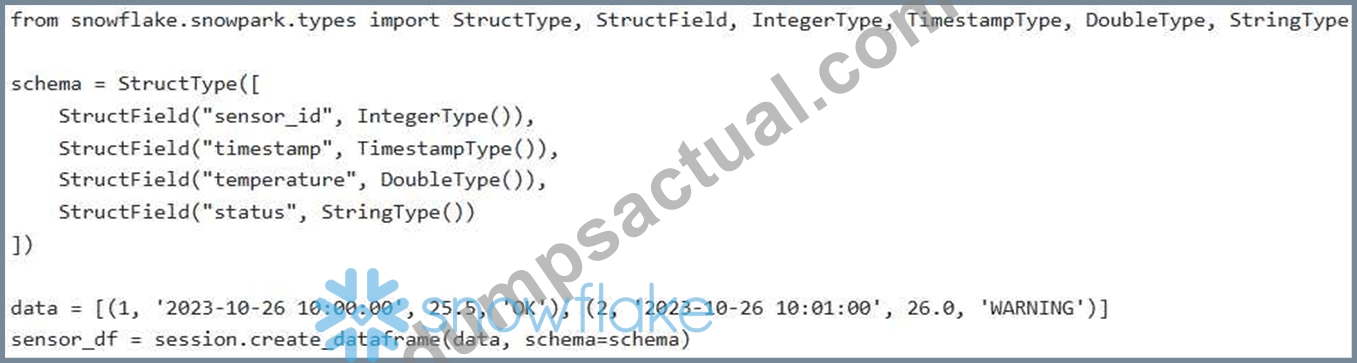
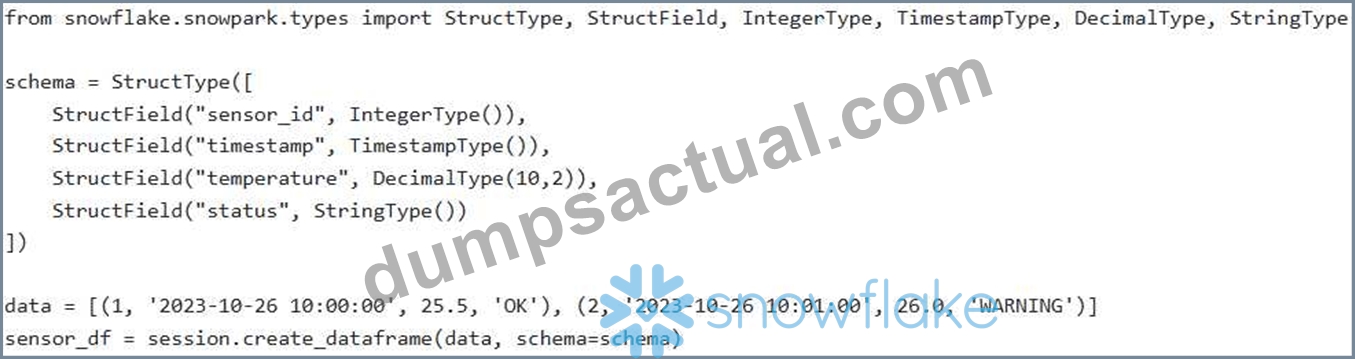
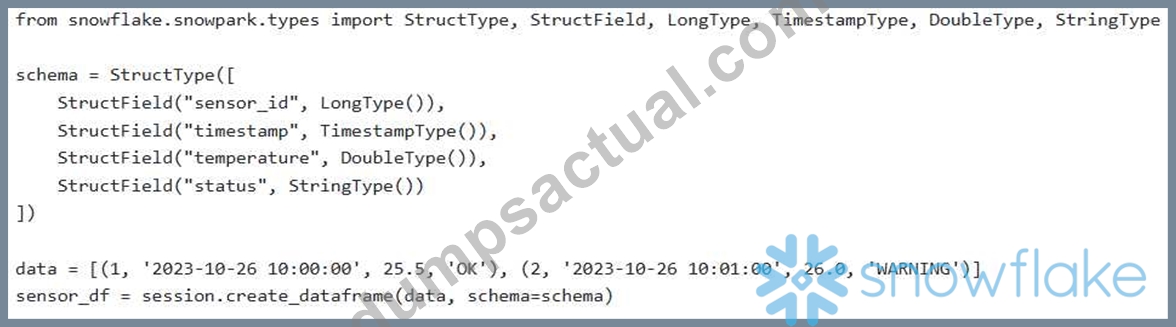
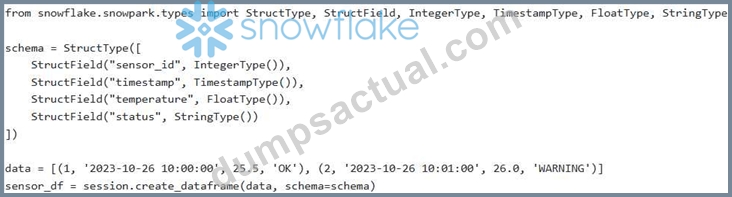
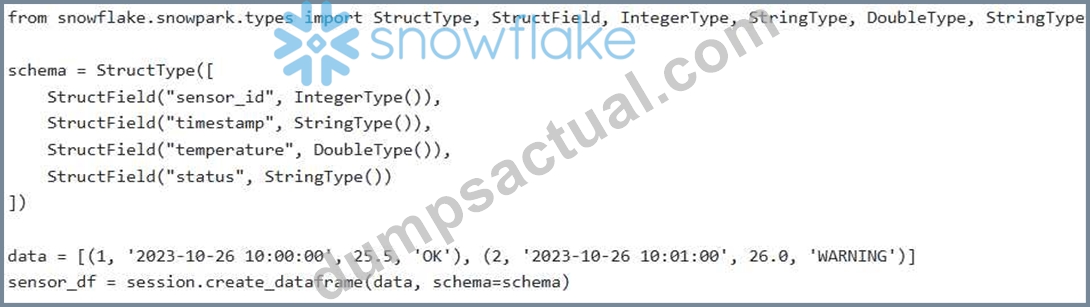
You are working with sensor data in Snowpark. Your data contains (Integer), 'timestamp' (Timestamp), 'temperature' (Double), and 'status' (String). You need to create a Snowpark DataFrame named representing this data'. Which of the following is the most efficient and type-safe way to create the DataFrame from a list of Python tuples using an explicitly defined schema, assuming you need to maintain maximum precision for temperature readings and that all data types should map to the most efficient and appropriate Snowflake data type?
- A.
- B.
- C.
- D.
- E.
Answer: A
Explanation:
Option B is the most efficient and type-safe way to create the DataFrame. It correctly maps each data element to its most appropriate Snowpark data type: Integer Type for 'sensor_id' , TimestampType for 'timestamp' , DoubleType for 'temperature' (as it offers more precision than FloatType for Snowflake), and StringType for 'status'. While DecimalType could be considered for representing exact numeric values, it's often used for currency or financial data where exact representation is critical. In this case, DoubleType is sufficient for temperature readings. Timestamp values are automatically converted from the string representation. FloatType has less precision than DoubleType. Using LongType for sensor_id might be overkill if the IDs are reasonably small integers. Using StringType for timestamp will require later conversion for time based calculation.
NEW QUESTION # 152
You have a large CSV file containing product descriptions that you need to analyze using a sentiment analysis UDF. The CSV file is too large to fit in memory on your local machine. You want to stream the data directly from a Snowflake stage to your UDF for processing, avoiding the need to download the entire file. Which of the following approaches allows you to achieve this using Snowpark?
- A. Use the 'snowflake.connector' library within the UDF to establish a new connection to Snowflake, read the CSV file from the stage, and analyze the product descriptions.
- B. Load the CSV file into a Snowflake internal stage. Then, within a Snowpark UDF, directly query the stage using SQL to retrieve and analyze the product descriptions.
- C. Read the CSV file directly into a Pandas DataFrame using within the UDF and perform sentiment analysis on the DataFrame.
- D. Create an external table pointing to the CSV file on the stage. Use a Snowpark DataFrame to select the product descriptions from the external table and then apply the sentiment analysis UDF.
- E. Use the method within the UDF to read the CSV file line by line and pass each product description to the sentiment analysis function.
Answer: D
Explanation:
Option B is the correct approach. Creating an external table allows you to treat the CSV file on the stage as a regular table within Snowflake. You can then use a Snowpark DataFrame to query this external table and efficiently process the data in parallel using the sentiment analysis UDF. Option A is not feasible because you cannot directly load the file into Pandas, as it requires the file to be local to UDF execution environment, defeating the purpose of using a stage directly. Option C: is not intended for reading arbitrary files; it's typically used for Snowpipe ingestion. Option D introduces unnecessary data movement and complexity. Option E is discouraged due to security concems and potential resource conflicts; UDFs should not establish new connections to Snowflake.
NEW QUESTION # 153
You have a Snowflake table 'user_profiles' with a VARIANT column 'profile_data'. This column contains JSON objects, and one of the fields within these objects is an array called 'interests'. The 'interests' array contains JSON objects, each with 'name' and 'category' fields. You need to use Snowpark to flatten the 'interests' array and extract the 'name' and 'category' for all user profiles, but only for profiles where the user's 'status' is 'active'. You want to write this in the most efficient way possible. Which of the following code snippets will achieve this?
- A.

- B.

- C.

- D.

- E.

Answer: D
Explanation:
Option E is the most efficient. Filtering the data frame for 'active' profiles before exploding the 'interests' array reduces the number of rows the explode function needs to process, thus minimizing the computational load and optimizing query performance. Options A and B performs explodes first and then filters and hence, not very performant. D is not valid syntax for Snowpark. C selects the data first but the performnace is not at par with E.
NEW QUESTION # 154
You have a Snowpark DataFrame named with the following schema: '(timestamp: TmestampType, sensor_id: StringType, value: FloatType)'. You need to identify the top 3 sensors with the highest average value over the entire dataset. Which of the following Snowpark Python code snippets correctly implements this requirement?
- A.

- B.

- C.

- D.

- E.

Answer: D
Explanation:
Option A provides the correct and most concise solution. It groups the 'sensor_data' DataFrame by , calculates the average value for each sensor using , orders the results by the average value in descending order using ascending-Falsey , and then limits the results to the top 3 sensors using 'limit(3)'. Option B attempts to use window function over the entire dataset without grouping by sensor, the result would be incorrect. Option C incorrectly attempts to use window specification without partition. Option D is similar as C with missing group by partition. Option E use 'sort' instead of 'orderBy' .
NEW QUESTION # 155
A Snowpark Python application is failing intermittently with a 'net.snowflake.client.jdbc.SnowflakeSQLException: SQL execution error: Remote service internal error [Errorld: ...l' when calling 'df.collect()' on a DataFrame that results from joining multiple tables and applying a complex filter. The data volume is substantial, but within the warehouse's expected capacity. Which of the following actions are MOST likely to resolve this issue? (Select two)
- A. Replace with 'df.toPandas(Y to improve memory management on the client side.
- B. Implement retry logic around the 'df.collect()' call with exponential backoff, assuming the error is transient due to resource contention.
- C. Switch to using the function with a raw SQL query instead of Snowpark DataFrame operations.
- D. Increase the parameter to a higher value to prevent session timeouts.
- E. Break down the complex query into smaller, intermediate DataFrames and persist them using to avoid memory pressure during a single large query.
Answer: B,E
Explanation:
Options B and C are the most likely to resolve the issue. Option B addresses potential memory pressure within Snowflake by breaking down the query and persisting intermediate results. Option C acknowledges that the error might be transient due to resource contention and implements retry logic. Increasing (A) is unlikely to solve a remote service internal error. 'df.toPandas()' (D) might exacerbate the problem by moving more data to the client. Using (E) is a workaround, but doesn't address the underlying problem within Snowpark and could reduce performance if not carefully optimized.
NEW QUESTION # 156
You are developing a Snowpark stored procedure to process PDF files stored in a Snowflake stage. You need to extract text from these PDF files and store the extracted text in a Snowflake table. Due to security requirements, you cannot use any external packages that require internet access. Which of the following approaches can you use to accomplish this task securely and efficiently? (Select all that apply)
- A. Use the function to read the PDF files as binary data. Implement a pure-Python PDF parsing library directly within the stored procedure to extract the text. Ensure the library code is included directly in the stored procedure code.
- B. Use Snowpark's built-in PDF parsing functions to extract the text. Snowflake provides native support for PDF parsing, eliminating the need for external libraries.
- C. Develop a custom Java UDF (User-Defined Function) that uses a secure, open-source PDF parsing library (e.g., PDFBox) and register it with Snowflake. Call this UDF from the Snowpark stored procedure to extract the text.
- D. Implement an external function using AWS Lambda or Azure Functions to parse the PDF files and extract the text. Configure the external function to have no internet access.
- E. Convert the PDF files to a text-based format (e.g., TXT) using an external tool before loading them into Snowflake. Then, use Snowpark to process the text files.
Answer: A,C
Explanation:
Options B and C are correct. Option B: Java UDFs allow you to leverage existing Java libraries (like PDFBox, which can be included in the UDF's JAR file) to parse PDFs securely within the Snowflake environment. Option C: Using and a pure-Python PDF parsing library (which doesn't require external network access) is another viable approach. The entire library's code must be embedded within the stored procedure. Option A is incorrect because Snowflake does not have built-in PDF parsing functions. Option D is not ideal as you are trying to avoid any external dependencies and internet access. Option E, although workable, adds an external preprocessing step which isn't the most efficient way.
NEW QUESTION # 157
You are developing a Snowpark application that performs complex data transformations on a large dataset using a UDF written in Scala.
After deploying the application, you observe that the performance is significantly slower than expected. Analyzing the query history in Snowflake, you identify that the UDF execution time is unusually high. Which of the following actions would be MOST effective in improving the performance of the UDF, considering Snowpark's execution context and Snowflake's query processing?
- A. Modify the Scala UDF to leverage Snowpark's vectorized UDF functionality (using 'VectorizedUDF) to process data in batches instead of row-by-row.
- B. Rewrite the Scala UDF using SQL stored procedure for better performance.
- C. Increase the warehouse size to improve overall query processing capacity, even if the UDF code itself remains unchanged.
- D. Change the UDF definition to return smaller data types if applicable.
- E. Increase the amount of memory allocated to the Snowpark session in the application code.
Answer: A,D
Explanation:
Using vectorized UDFs allows processing data in batches, significantly reducing overhead. Returning smaller datatypes optimizes I/O and memory usage. While increasing the warehouse size might offer some improvement, it doesn't directly address the UDF's inefficiency. Snowpark session memory is more relevant for the driver program and less so for the execution of the UDF within Snowflake's environment. SQL Stored procedures are useful but for functions already supported in SQL; vectorized UDFs provide a path fomard for scala code.
NEW QUESTION # 158
You have a Snowpark DataFrame named 'employee_df in VS Code. You want to define a user-defined function (UDF) in Python that calculates the bonus for each employee based on their salary and performance rating. The UDF should take the salary (SALARY) and performance rating (PERFORMANCE RATING) as inputs and return the bonus amount. Assume you have already established a Snowpark session. Which code snippet accurately defines and registers a UDF named 'calculate_bonus' that can be applied to the 'employee_df DataFrame?
- A.

- B.

- C.

- D.

- E.

Answer: C,D
Explanation:
Options A and B are both correct methods. Option A defines the Python function and then registers it as a UDF using session.udf.register' . It explicitly specifies the return type, input types, UDF name, and the 'replace=True' option to allow overwriting if the UDF already exists. Option B uses the guff decorator to directly register the function as a UDF, providing a more concise way to define and register UDFs. Option A is also valid as the user defined datatypes and name. Option C requires the snowflake-snowpark-python package (which is already installed via dependencies) and the 'fune argument is redundant. Option D is wrong as would remove the currently configured packages. Option E is incorrect because making the UDF permanent requires additional privileges and setup that aren't covered by default.
NEW QUESTION # 159
A data engineering team has created several Snowpark Python UDFs and UDTFs in the 'TRANSFORMATIONS' schema of the 'ANALYTICS' database. A data science team needs to use these functions in their data analysis notebooks. What is the MINIMUM set of privileges that must be granted to the data science team's role ('DATA SCIENTIST') to allow them to discover and execute these UDFs and UDTFs?
- A. GRANT ALL PRIVILEGES ON DATABASE ANALYTICS TO ROLE DATA SCIENTIST; GRANT ALL PRIVILEGES ON SCHEMA ANALYTICS.TRANSFORMATIONS TO ROLE DATA SCIENTIST;
- B. GRANT USAGE ON DATABASE ANALYTICS TO ROLE DATA SCIENTIST; GRANT USAGE ON SCHEMAANALYTICS.TRANSFORMATIONS TO ROLE DATA SCIENTIST; GRANT ALL PRIVILEGES ON ALL FUNCTIONS IN SCHEMAANALYTICS.TRANSFORMATIONS TO ROLE DATA SCIENTIST;
- C. GRANT USAGE ON DATABASE ANALYTICS TO ROLE DATA SCIENTIST; GRANT USAGE ON SCHEMAANALYTICS.TRANSFORMATIONS TO ROLE DATA SCIENTIST; GRANT EXECUTE ON ALL FUNCTIONS IN SCHEMAANALYTICS.TRANSFORMATIONS TO ROLE DATA SCIENTIST,
- D. GRANT EXECUTE ON ALL FUNCTIONS IN SCHEMAANALYTICS.TRANSFORMATIONS TO ROLE DATA SCIENTIST;
- E. GRANT USAGE ON DATABASE ANALYTICS TO ROLE DATA SCIENTIST; GRANT USAGE ON SCHEMAANALYTICS.TRANSFORMATIONS TO ROLE DATA SCIENTIST;
Answer: C
Explanation:
The 'USAGE privilege on the database and schema is required for the role to discover (see) the UDFs and UDTFs. The 'EXECUTE privilege on the functions themselves is required to execute them. 'ALL PRIVILEGES' is an overly permissive grant and not the minimum required. Option D is missing the execute privilege. Option E is missing USAGE on Database and Schema.
NEW QUESTION # 160
You are tasked with creating a Snowpark UDTF (User-Defined Table Function) in Python to process a large CSV file stored in a Snowflake stage. Each row in the CSV represents a transaction, and you need to parse each row and extract specific fields based on a complex set of rules. The UDTF should return a table with the extracted fields. Consider the following code snippet:
- A. The UDTF will fail because the 'yield' statement is being called after using 'return' in the processing block. Remove the yield statement as it is incompatible.
- B. The UDTF will run, but it will be slow due to the use of pandas DataFrame operations within the UDTF. Consider optimizing the code to use Snowpark DataFrame operations instead.
- C. The UDTF will run but will not return any data since the code currently lacks a 'session' object properly initialized for Snowpark operations inside the handler. Ensure the handler method has the session parameter and uses it.
- D. The code will raise an error because the 'read_csvs function is not available within the Snowpark UDTF context. The input needs to be processed differently.
- E. The UDTF will execute correctly and efficiently in Snowpark, correctly processing each row of the CSV and returning the extracted fields as a table.
Answer: B
Explanation:
While the provided code snippet might function, it's fundamentally inefficient. UDTFs in Snowpark are most performant when leveraging Snowpark DataFrame operations. Using 'pandas' inside the UDTF serializes and deserializes data between the Snowflake engine and the Python environment, introducing significant overhead. Options B, D and E are all generally incorrect as the code snippet provided is syntactically okay and contains the session parameter. A is incorrect due to performance and lack of optimization.
NEW QUESTION # 161
You have a Snowpark Python stored procedure named 'calculate_stats' that takes a table name as input and returns summary statistics. You need to modify the stored procedure to add a new optional parameter for specifying a filter condition. Which of the following SQL commands, used in conjunction with the Snowpark API for Python, is the MOST efficient way to alter the existing stored procedure without dropping and recreating it?
- A.

- B.

- C.

- D.

- E.

Answer: C
Explanation:
'CREATE OR REPLACE PROCEDURE is the standard and efficient way to modify stored procedures in Snowflake, including adding optional parameters. It avoids dropping and recreating the procedure, preserving grants and dependencies. Option B accurately defines a new procedure definition that incorporates both input parameters and sets a default NULL value for the filter condition which makes it optional. Other Options not efficient , Option A, drops old and creates new SP. Options C & D are invalid SQL Syntax, and E makes the FILTER_CONDITION mandatory.
NEW QUESTION # 162
......
Get Latest [Aug-2026] Conduct effective penetration tests using DumpsActual SPS-C01: https://examcollection.dumpsactual.com/SPS-C01-actualtests-dumps.html
