

Pass Huawei H12-821_V1.0 Exam with Guarantee Updated 1265 Questions
Latest H12-821_V1.0 Pass Guaranteed Exam Dumps Certification Sample Questions
NEW QUESTION # 109
On an RSTP network, port priorities may be compared during root port or designated port election. Which of the following values is the default priority of a port on a Huawei switch?
- A. 0
- B. 1
- C. 2
- D. 3
Answer: D
Explanation:
Comprehensive and Detailed Step-by-Step Explanation:
1. Port Priority in RSTP:
* RSTP (Rapid Spanning Tree Protocol) elects root and designated ports based on port priority and port ID.
* Port priority is a configurable value that helps determine which port becomes the root or designated port when multiple ports are eligible.
* The port ID consists of the port priority and port number. When priorities are equal, the port number is used as a tiebreaker.
2. Default Port Priority on Huawei Switches:
* On Huawei switches, the default port priority is 128.
* This value can be adjusted in increments of 16 using the command stp port priority.
3. Analysis of Options:
Option A: 1
* Incorrect. This is not the default port priority value.
Option B: 128
* Correct. This is the default port priority value on Huawei switches.
Option C: 4096
* Incorrect. This is not a valid default port priority value.
Option D: 32768
* Incorrect. This is the default bridge priority, not the port priority.
4. Summary:
* The default port priority on Huawei switches is 128.
:
Huawei HCIA-Datacom Study Guide, Chapter "RSTP Port Role Election."
IEEE 802.1D-2004: Rapid Spanning Tree Protocol (RSTP).
NEW QUESTION # 110
Which of the following descriptions of MAC address spoofing attacks is incorrect?
- A. A MAC address spoofing attack will cause the data that the switch wants to send to the correct destination to be sent to the attacker.
- B. An attacker can implement a MAC address spoofing attack by sending a data frame with a forged source MAC address to the switch.
- C. MAC address spoofing attacks mainly utilize the switch MAC address learning mechanism.
- D. MAC address spoofing attacks will cause the switch to learn the wrong mapping relationship between MAC addresses and IP addresses.
Answer: D
NEW QUESTION # 111
As shown in the figure, the stateful inspection firewall forwards the packet because the packet matches the session status of the firewall.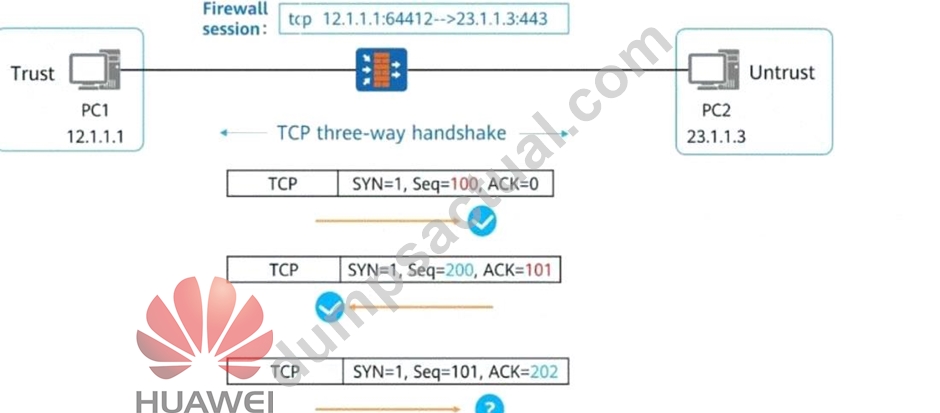
- A. TRUE
- B. FALSE
Answer: A
Explanation:
A stateful inspection firewall tracks the state of active connections. If a packet matches an existing session in the firewall's state table, it is allowed to pass. The diagram indicates that the TCP packet matches the session state, so the firewall forwards it .
NEW QUESTION # 112
The technology that separates the control plane and forwarding plane is SDN.
- A. FALSE
- B. TRUE
Answer: A
NEW QUESTION # 113
In VRRP, when devices in the same backup group perform VRRP packet authentication, which of the following parameters will not affect the authentication negotiation results between the Master device and the Backup device?
- A. Priority
- B. Authentication word
- C. Authentication method
- D. VRRP version
Answer: A
NEW QUESTION # 114
Which description of Route Policy is correct? (Multiple choice)
- A. The if-match clause is used to determine the matching conditions of the node, and the apply clause is used to define the routing behavior through filtering.
- B. The filtering rule relationship of the if-match clause is "AND", that is, all i-match clauses of the node must match
- C. The relationship between Route-Policy nodes is "or". As long as it passes the filtering of one node, it can pass the Route-Policy.
- D. A Route-Policy consists of multiple nodes. A section can contain multiple if-match and apply clauses
Answer: A,B,C,D
NEW QUESTION # 115
In the MSTP domain, multiple spanning trees can be generated based on instance calculations, and each spanning tree is called an MSTI.
Which of the following descriptions about MSTI is correct? (Multiple choice)
- A. The role and status of each port on different MSTIs can be different
- B. The spanning tree of each MSTI can have different roots and different topologies
- C. Each MSTI can share parameters to calculate its own spanning tree
- D. The spanning tree parameters of each port on different MSTIs can be different
Answer: A,B,D
NEW QUESTION # 116
A firewall receives a packet that PC1 sends to PC2. Which of the following statements are true?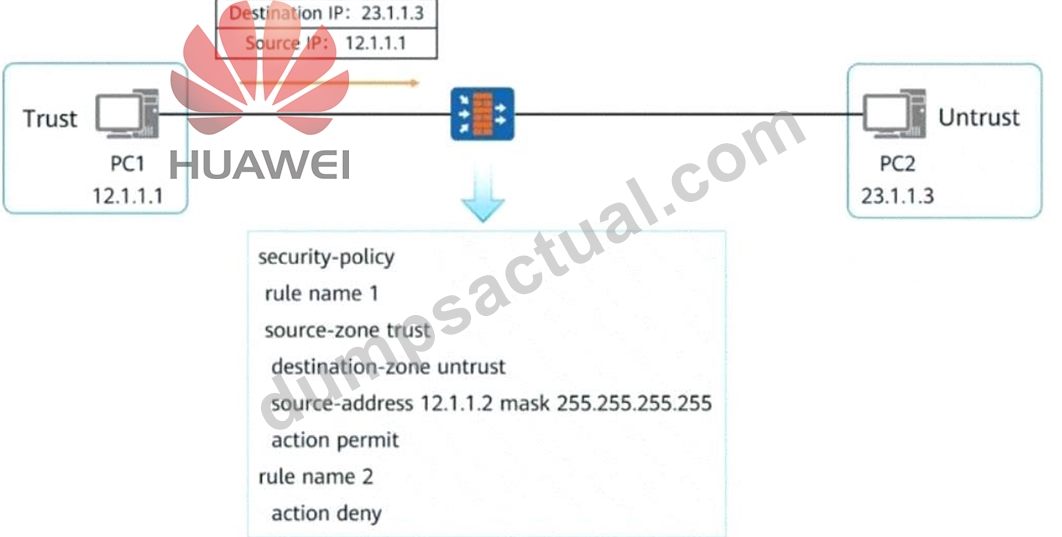
- A. The packet matches security policy rule 1, and the firewall discards the packet.
- B. The packet matches security policy rule 1, and the firewall forwards the packet.
- C. No source or destination security zone is specified in security policy rule 2, indicating that any security zone is a match.
- D. The packet does not match any security policy.
Answer: B
Explanation:
The security policy specifies that traffic originating from 12.1.1.2 and destined for the untrust zone is permitted. Since the source address of the packet (12.1.1.1) does not match this rule, the packet matches the default implicit deny rule. However, rule 1 does not deny all other traffic explicitly, so the packet is forwarded based on further configurations .
NEW QUESTION # 117
An enterprise network runs OSPF to implement network communication. Which of the following types of LSAs may be generated by an ABR?
- A. AS External LSA
- B. NSSA LSA
- C. ASBR Summary LSA
- D. Network Summary LSA
Answer: B,C,D
Explanation:
Comprehensive and Detailed in-depth Step-by-Step Explanation:
AnArea Border Router (ABR)is an OSPF router that connects multiple areas, including the backbone area (Area 0). It plays a critical role in summarizing and propagating routing information between areas. The types of LSAs that an ABR can generate include:
Network Summary LSA (Type 3):
ABRs generate Type 3 LSAs to summarize and propagate routes from one area into another.
For example, an ABR generates a Type 3 LSA to inform other areas about the networks in the area it is connected to.
ASBR Summary LSA (Type 4):
If an ASBR exists in one of the OSPF areas connected to the ABR, the ABR generates Type 4 LSAs.
These LSAs provide information about how to reach the ASBR.
NSSA LSA (Type 7):
If the ABR is connected to a Not-So-Stubby Area (NSSA), it can generate Type 7 LSAs.
These LSAs are used to describe external routes imported into the NSSA.
AS External LSA (Type 5):
These LSAs are not typically generated by an ABR unless the ABR is also functioning as an ASBR. Type 5 LSAs are used to describe external routes imported into OSPF from other autonomous systems.
Therefore,NSSA LSA (A),Network Summary LSA (C), andASBR Summary LSA (D)are valid answers.AS External LSA (B)would only be correct if the ABR were also functioning as an ASBR, but that is not explicitly stated in the question.
References:
Huawei HCIA-Datacom Study Guide, Chapter on "OSPF LSAs and ABR Functions".
RFC 2328 - OSPF Version 2.
NEW QUESTION # 118
Which of the following statements regarding the OSPF protocol is false?
- A. Link State ID in a Type 3 LSA indicates the router ID of an ABR.
- B. Router-LSA describes four connection types: P2P, TransNet, SubNet, and virtual link.
- C. Each OSPF router uses only one Router-LSA to describe the local active connection status of an area.
- D. Routing information can be advertised only between backbone and non-backbone areas and cannot be advertised directly between non-backbone areas.
Answer: A
Explanation:
The Link State ID in a Type 3 LSA (Summary LSA) indicates the network or subnet being summarized, not the router ID of an ABR. All other statements accurately describe OSPF functionality, making D the false statement .
NEW QUESTION # 119
A network entity title consists of an area address and a system ID. It is a special NSAP (the SEL has a fixed value of 00) and is mainly used for route calculation.
- A. TRUE
- B. FALSE
Answer: A
Explanation:
Comprehensive and Detailed in-depth Step-by-Step Explanation:The Network Entity Title (NET) is a unique identifier assigned to an IS-IS router. It is derived from the Network Service Access Point (NSAP) address and consists of the following components:
* Area Address:
* Identifies the area in which the router resides.
* Multiple routers in the same IS-IS area must have the same area address.
* System ID:
* Uniquely identifies the router within the IS-IS area.
* The System ID is typically derived from the router's loopback IP address or another unique value.
* SEL (Selector Field):
* The SEL field is always set to 00 for IS-IS NETs.
The NET is used by IS-IS for route calculation and to identify the router within the IS-IS domain. Therefore, the statement is TRUE.
References:
* Huawei HCIA-Datacom Study Guide, Chapter on "IS-IS Addressing".
* RFC 1195 - Use of OSI IS-IS for Routing in TCP/IP and Dual Environments.
NEW QUESTION # 120
All single switches in the stack system are called member switches and can be divided into different roles according to their functions. Please match the roles of the following member switches with their functions.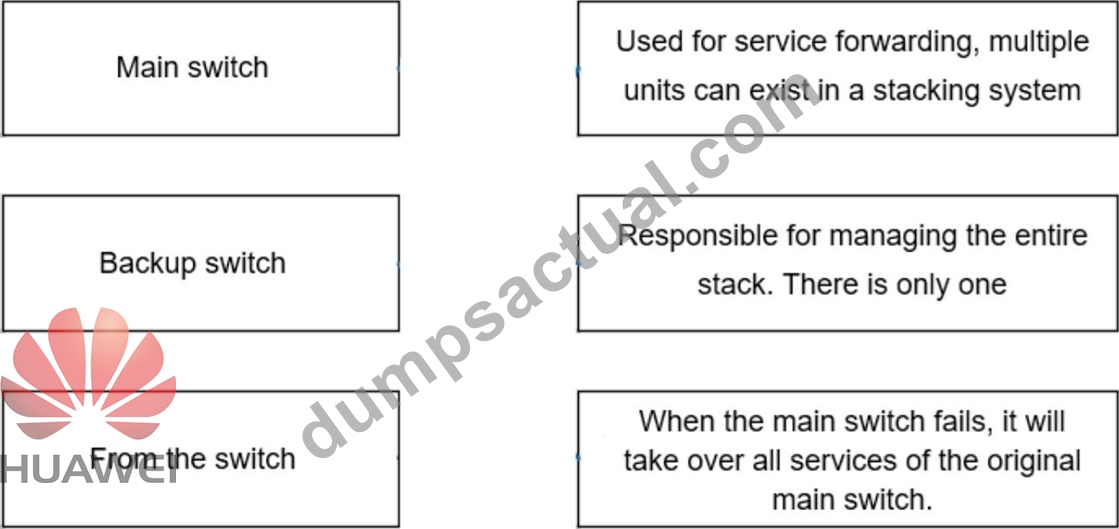
Answer:
Explanation: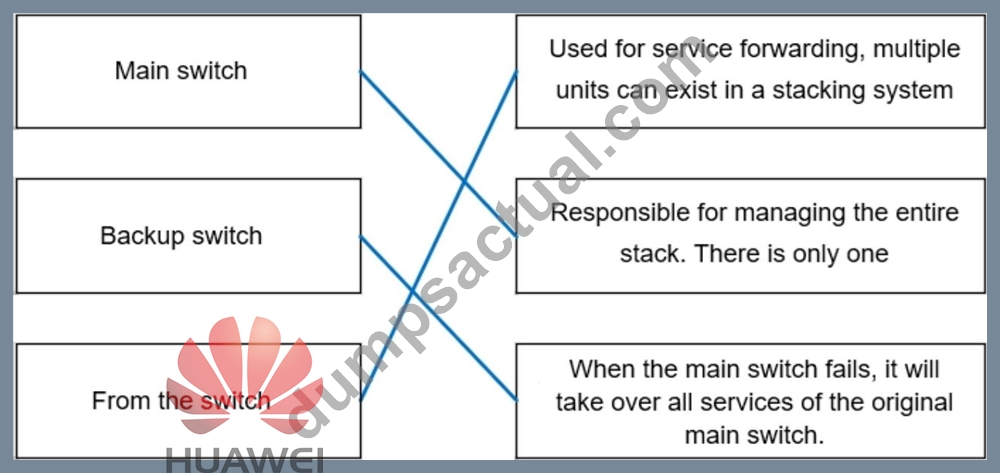
NEW QUESTION # 121
In dual-link hot backup, the AP will establish CAPWAP links with the main AC and backup AC.
- A. TRUE
- B. FALSE
Answer: A
NEW QUESTION # 122
OSPF has multiple types of routes with varying priorities. Which of the following types of routes has the lowest priority when they have the same prefix?
- A. Type 1 external route
- B. Inter-area route
- C. Intra-area route
- D. Type 2 external route
Answer: D
Explanation:
OSPF Route Preference Hierarchy:
OSPF uses the following preference order for route types when the prefix is the same:
Intra-area routes (D): Routes within the same OSPF area have the highest priority.
Inter-area routes (B): Routes between different OSPF areas are preferred after intra-area routes.
Type 1 external routes (A): External routes redistributed into OSPF, considering the internal OSPF cost to the ASBR.
Type 2 external routes (C): External routes redistributed into OSPF, ignoring the internal OSPF cost to the ASBR.
Lowest Priority:
Type 2 external routes (C) are given the lowest priority because they represent external information that does not consider internal OSPF costs.
NEW QUESTION # 123
There are many employees in a certain enterprise building, and they usually start to connect to the company's WLAN network in the lobby when they go to work.
As each employee walks to their respective workstations, each person's mobile terminal roams through roaming to their respective network coverage areas.
In order to try to ensure that the IP address of each terminal is fixed, what is the recommended method?
- A. Configure the VLAN Pool and configure the sequence algorithm
- B. Do not configure VLAN Pool, configure a static IP address for each mobile terminal
- C. Configure VLAN Pool, any configuration algorithm
- D. Configure VLAN Pool and configure Hash algorithm
Answer: D
NEW QUESTION # 124
As shown in the figure, OSPF is enabled on all interfaces of the router. The cost value of the link is marked in the figure. Interface 0 of R2 Loopback0 is advertised in area 0. In area 1, R2 and R3 will transmit 10.0 in the form of Type3 LSA. 2.2/32 routing information.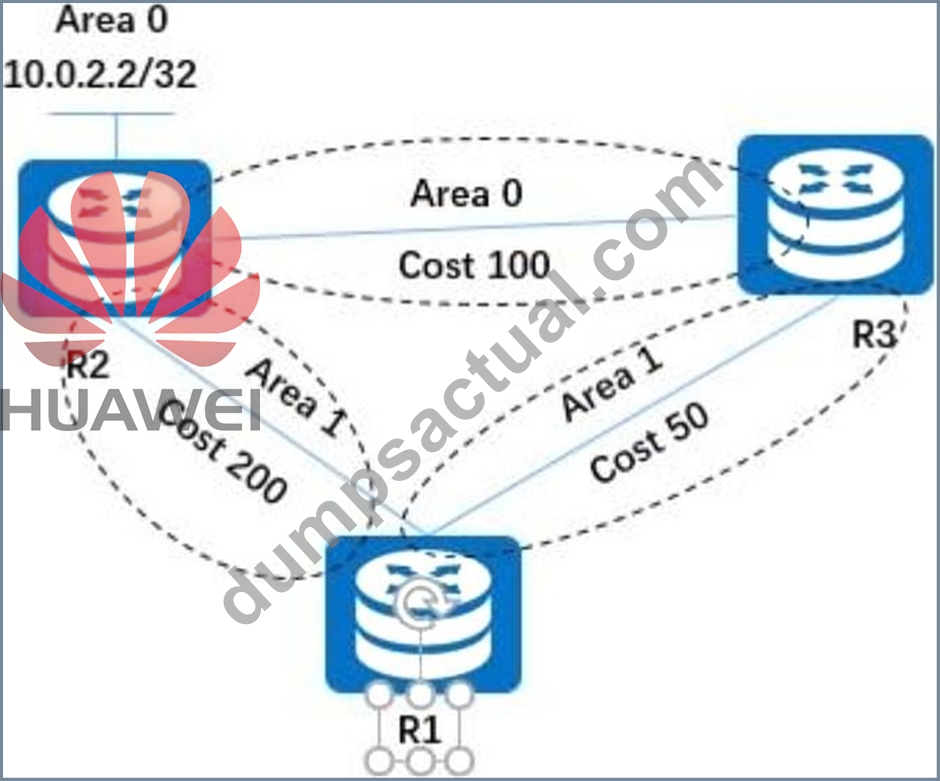
- A. TRUE
- B. FALSE
Answer: A
NEW QUESTION # 125
......
Huawei H12-821_V1.0 (HCIP-Datacom-Core Technology V1.0) certification exam is a professional-level certification offered by Huawei Technologies Co., Ltd. HCIP-Datacom-Core Technology V1.0 certification is designed to validate the skills and knowledge required to design, deploy, and manage large-scale data communication networks using Huawei technologies. H12-821_V1.0 exam covers a wide range of topics, including network architecture, protocols, security, and troubleshooting.
New H12-821_V1.0 Test Materials & Valid H12-821_V1.0 Test Engine: https://examcollection.dumpsactual.com/H12-821_V1.0-actualtests-dumps.html
