

Authentic Best resources for Databricks-Certified-Data-Engineer-Associate Test Engine Practice Exam
[2025] Databricks-Certified-Data-Engineer-Associate PDF Questions - Perfect Prospect To Go With DumpsActual Practice Exam
Databricks Certified Data Engineer Associate Exam is a vendor-neutral certification that tests candidates on their understanding of Databricks architecture and features, data ingestion and processing, data transformation and storage, and machine learning. Databricks-Certified-Data-Engineer-Associate exam also covers important concepts such as performance tuning, security, and troubleshooting in Databricks. Passing the exam demonstrates that a candidate has the skills, knowledge, and expertise to work with Databricks to design, build, and maintain advanced data pipelines and solutions.
NEW QUESTION # 61
A data organization leader is upset about the data analysis team's reports being different from the data engineering team's reports. The leader believes the siloed nature of their organization's data engineering and data analysis architectures is to blame.
Which of the following describes how a data lakehouse could alleviate this issue?
- A. Both teams would use the same source of truth for their work
- B. Both teams would reorganize to report to the same department
- C. Both teams would respond more quickly to ad-hoc requests
- D. Both teams would autoscale their work as data size evolves
- E. Both teams would be able to collaborate on projects in real-time
Answer: A
Explanation:
A data lakehouse is a data management architecture that combines the flexibility, cost-efficiency, and scale of data lakes with the data management and ACID transactions of data warehouses, enabling business intelligence (BI) and machine learning (ML) on all data12. By using a data lakehouse, both the data analysis and data engineering teams can access the same data sources and formats, ensuring data consistency and quality across their reports. A data lakehouse also supports schema enforcement and evolution, data validation, and time travel to old table versions, which can help resolve data conflicts and errors1. References: 1: What is a Data Lakehouse? - Databricks 2: What is a data lakehouse? | IBM
NEW QUESTION # 62
A single Job runs two notebooks as two separate tasks. A data engineer has noticed that one of the notebooks is running slowly in the Job's current run. The data engineer asks a tech lead for help in identifying why this might be the case.
Which of the following approaches can the tech lead use to identify why the notebook is running slowly as part of the Job?
- A. They can navigate to the Runs tab in the Jobs UI and click on the active run to review the processing notebook.
- B. They can navigate to the Tasks tab in the Jobs UI and click on the active run to review the processing notebook.
- C. They can navigate to the Runs tab in the Jobs UI to immediately review the processing notebook.
- D. There is no way to determine why a Job task is running slowly.
- E. They can navigate to the Tasks tab in the Jobs UI to immediately review the processing notebook.
Answer: B
Explanation:
The Tasks tab in the Jobs UI shows the list of tasks that are part of a job, and allows the user to view the details of each task, such as the notebook path, the cluster configuration, the run status, and the duration. By clicking on the active run of a task, the user can access the Spark UI, the notebook output, and the logs of the task. These can help the user to identify the performance bottlenecks and errors in the task. The Runs tab in the Jobs UI only shows the summary of the job runs, such as the start time, the end time, the trigger, and the status. It does not provide the details of the individual tasks within a job run. References: Jobs UI, Monitor running jobs with a Job Run dashboard, How to optimize jobs performance
NEW QUESTION # 63
Which of the following describes a benefit of creating an external table from Parquet rather than CSV when using a CREATE TABLE AS SELECT statement?
- A. Parquet files have the ability to be optimized
- B. Parquet files can be partitioned
- C. Parquet files will become Delta tables
- D. CREATE TABLE AS SELECT statements cannot be used on files
- E. Parquet files have a well-defined schema
Answer: E
Explanation:
Explanation
https://www.databricks.com/glossary/what-is-parquet#:~:text=Columnar%20storage%20like%20Apache%20Par Columnar storage like Apache Parquet is designed to bring efficiency compared to row-based files like CSV.
When querying, columnar storage you can skip over the non-relevant data very quickly. As a result, aggregation queries are less time-consuming compared to row-oriented databases.
NEW QUESTION # 64
Which of the following benefits of using the Databricks Lakehouse Platform is provided by Delta Lake?
- A. The ability to collaborate in real time on a single notebook
- B. The ability to set up alerts for query failures
- C. The ability to support batch and streaming workloads
- D. The ability to distribute complex data operations
- E. The ability to manipulate the same data using a variety of languages
Answer: C
Explanation:
Explanation
Delta Lake is a key component of the Databricks Lakehouse Platform that provides several benefits, and one of the most significant benefits is its ability to support both batch and streaming workloads seamlessly. Delta Lake allows you to process and analyze data in real-time (streaming) as well as in batch, making it a versatile choice for various data processing needs. While the other options may be benefits or capabilities of Databricks or the Lakehouse Platform in general, they are not specifically associated with Delta Lake.
NEW QUESTION # 65
Which of the following is hosted completely in the control plane of the classic Databricks architecture?
- A. JDBC data source
- B. Databricks web application
- C. Worker node
- D. Driver node
- E. Databricks Filesystem
Answer: B
Explanation:
The Databricks web application is the user interface that allows you to create and manage workspaces, clusters, notebooks, jobs, and other resources. It is hosted completely in the control plane of the classic Databricks architecture, which includes the backend services that Databricks manages in your Databricks account. The other options are part of the compute plane, which is where your data is processed by compute resources such as clusters. The compute plane is in your own cloud account and network.
References: Databricks architecture overview, Security and Trust Center
NEW QUESTION # 66
Which of the following code blocks will remove the rows where the value in column age is greater than 25 from the existing Delta table my_table and save the updated table?
- A. DELETE FROM my_table WHERE age <= 25;
- B. SELECT * FROM my_table WHERE age > 25;
- C. DELETE FROM my_table WHERE age > 25;
- D. UPDATE my_table WHERE age <= 25;
- E. UPDATE my_table WHERE age > 25;
Answer: C
Explanation:
1: The DELETE command in Delta Lake allows you to remove data that matches a predicate from a Delta table. This command will delete all the rows where the value in the column age is greater than 25 from the existing Delta table my_table and save the updated table. The other options are either incorrect or do not achieve the desired result. Option A will only select the rows that match the predicate, but not delete them. Option B will update the rows that match the predicate, but not delete them. Option D will update the rows that do not match the predicate, but not delete them. Option E will delete the rows that do not match the predicate, which is the opposite of what we want. Reference: Table deletes, updates, and merges - Delta Lake Documentation
NEW QUESTION # 67
Which of the following Git operations must be performed outside of Databricks Repos?
- A. Merge
- B. Pull
- C. Push
- D. Clone
- E. Commit
Answer: A
Explanation:
Explanation
For following tasks, work in your Git provider:
Create a pull request.
Resolve merge conflicts.
Merge or delete branches.
Rebase a branch.
https://docs.databricks.com/repos/index.html
NEW QUESTION # 68
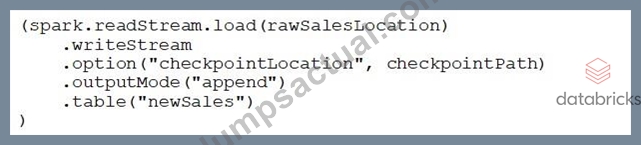
Which of the following Structured Streaming queries is performing a hop from a Silver table to a Gold table?
- A.

- B.
- C.

- D.

- E.
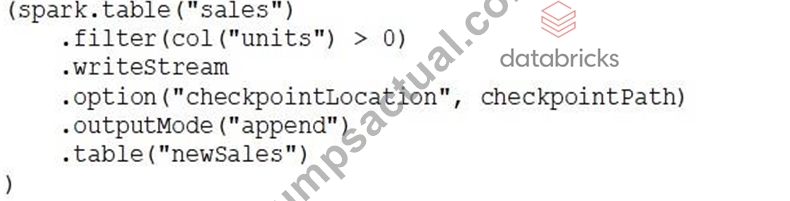
Answer: D
NEW QUESTION # 69
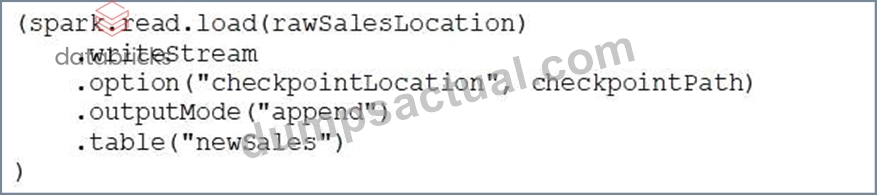
Which of the following Structured Streaming queries is performing a hop from a Silver table to a Gold table?
- A.

- B.

- C.

- D.
- E.

Answer: A
NEW QUESTION # 70
A data engineer is working with two tables. Each of these tables is displayed below in its entirety.
The data engineer runs the following query to join these tables together:
Which of the following will be returned by the above query?
- A. Option B
- B. Option D
- C. Option C
- D. Option E
- E. Option A
Answer: C
NEW QUESTION # 71
A dataset has been defined using Delta Live Tables and includes an expectations clause:
CONSTRAINT valid_timestamp EXPECT (timestamp > '2020-01-01') ON VIOLATION DROP ROW What is the expected behavior when a batch of data containing data that violates these constraints is processed?
- A. Records that violate the expectation are dropped from the target dataset and recorded as invalid in the event log.
- B. Records that violate the expectation are added to the target dataset and flagged as invalid in a field added to the target dataset.
- C. Records that violate the expectation are added to the target dataset and recorded as invalid in the event log.
- D. Records that violate the expectation are dropped from the target dataset and loaded into a quarantine table.
- E. Records that violate the expectation cause the job to fail.
Answer: A
Explanation:
Delta Live Tables expectations are optional clauses that apply data quality checks on each record passing through a query. An expectation consists of a description, a boolean statement, and an action to take when a record fails the expectation. The ON VIOLATION clause specifies the action to take, which can be one of the following: warn, drop, or fail. The drop action means that invalid records are dropped from the target dataset before data is written to the target. The failure is reported as a metric for the dataset, which can be viewed by querying the Delta Live Tables event log. The event log contains information such as the number of records that violate an expectation, the number of records dropped, and the number of records written to the target dataset. References:
* Manage data quality with Delta Live Tables
* Monitor Delta Live Tables pipelines
* Delta Live Tables SQL language reference
NEW QUESTION # 72
An engineering manager wants to monitor the performance of a recent project using a Databricks SQL query. For the first week following the project's release, the manager wants the query results to be updated every minute. However, the manager is concerned that the compute resources used for the query will be left running and cost the organization a lot of money beyond the first week of the project's release.
Which of the following approaches can the engineering team use to ensure the query does not cost the organization any money beyond the first week of the project's release?
- A. They can set a limit to the number of individuals that are able to manage the query's refresh schedule.
- B. They cannot ensure the query does not cost the organization money beyond the first week of the project's release.
- C. They can set the query's refresh schedule to end after a certain number of refreshes.
- D. They can set the query's refresh schedule to end on a certain date in the query scheduler.
- E. They can set a limit to the number of DBUs that are consumed by the SQL Endpoint.
Answer: D
Explanation:
In Databricks SQL, you can use scheduled query executions to update your dashboards or enable routine alerts. By default, your queries do not have a schedule. To set the schedule, you can use the dropdown pickers to specify the frequency, period, starting time, and time zone. You can also choose to end the schedule on a certain date by selecting the End date checkbox and picking a date from the calendar. This way, you can ensure that the query does not run beyond the first week of the project's release and does not incur any additional cost. Option A is incorrect, as setting a limit to the number of DBUs does not stop the query from running. Option B is incorrect, as there is no option to end the schedule after a certain number of refreshes. Option C is incorrect, as there is a way to ensure the query does not cost the organization money beyond the first week of the project's release. Option D is incorrect, as setting a limit to the number of individuals who can manage the query's refresh schedule does not affect the query's execution or cost. Reference: Schedule a query, Schedule a query - Azure Databricks - Databricks SQL
NEW QUESTION # 73
A data engineer runs a statement every day to copy the previous day's sales into the table transactions. Each day's sales are in their own file in the location "/transactions/raw".
Today, the data engineer runs the following command to complete this task: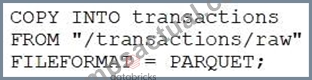
After running the command today, the data engineer notices that the number of records in table transactions has not changed.
Which of the following describes why the statement might not have copied any new records into the table?
- A. The previous day's file has already been copied into the table.
- B. The COPY INTO statement requires the table to be refreshed to view the copied rows.
- C. The PARQUET file format does not support COPY INTO.
- D. The names of the files to be copied were not included with the FILES keyword.
- E. The format of the files to be copied were not included with the FORMAT_OPTIONS keyword.
Answer: A
Explanation:
Explanation
https://docs.databricks.com/en/ingestion/copy-into/index.html The COPY INTO SQL command lets you load data from a file location into a Delta table. This is a re-triable and idempotent operation; files in the source location that have already been loaded are skipped. if there are no new records, the only consistent choice is C no new files were loaded because already loaded files were skipped.
NEW QUESTION # 74
Which of the following statements regarding the relationship between Silver tables and Bronze tables is always true?
- A. Silver tables contain aggregates while Bronze data is unaggregated.
- B. Silver tables contain more data than Bronze tables.
- C. Silver tables contain a less refined, less clean view of data than Bronze data.
- D. Silver tables contain less data than Bronze tables.
- E. Silver tables contain a more refined and cleaner view of data than Bronze tables.
Answer: B
Explanation:
Explanation
https://www.databricks.com/glossary/medallion-architecture
NEW QUESTION # 75
Which of the following describes a benefit of creating an external table from Parquet rather than CSV when using a CREATE TABLE AS SELECT statement?
- A. Parquet files have the ability to be optimized
- B. Parquet files can be partitioned
- C. Parquet files will become Delta tables
- D. CREATE TABLE AS SELECT statements cannot be used on files
- E. Parquet files have a well-defined schema
Answer: E
Explanation:
Option C is the correct answer because Parquet files have a well-defined schema that is embedded within the data itself. This means that the data types and column names of the Parquet files are automatically detected and preserved when creating an external table from them. This also enables the use of SQL and other structured query languages to access and analyze the data. CSV files, on the other hand, do not have a schema embedded in them, and require specifying the schema explicitly or inferring it from the data when creating an external table from them. This can lead to errors or inconsistencies in the data types and column names, and also increase the processing time and complexity.
References: CREATE TABLE AS SELECT, Parquet Files, CSV Files, Parquet vs. CSV
NEW QUESTION # 76
A data engineer has a Job that has a complex run schedule, and they want to transfer that schedule to other Jobs.
Rather than manually selecting each value in the scheduling form in Databricks, which of the following tools can the data engineer use to represent and submit the schedule programmatically?
- A. pyspark.sql.types.TimestampType
- B. pyspark.sql.types.DateType
- C. datetime
- D. There is no way to represent and submit this information programmatically
- E. Cron syntax
Answer: E
Explanation:
Cron syntax is a tool that can be used to represent and submit a complex run schedule programmatically. Cron syntax is a string of six fields that specify the frequency, date, and time of a job run. For example, the cron expression 0 0 12 * * ? means run the job at 12:00 PM every day. The data engineer can use the Databricks REST API to create or update a job with a cron schedule. The data engineer can also use the Databricks CLI to create or update a job with a cron schedule by using a JSON file that contains the cron expression. The other tools are either invalid or not suitable for representing and submitting a complex run schedule programmatically. Reference: Schedule a job, Jobs API, Databricks CLI, Cron expressions
NEW QUESTION # 77
A new data engineering team has been assigned to work on a project. The team will need access to database customers in order to see what tables already exist. The team has its own group team.
Which of the following commands can be used to grant the necessary permission on the entire database to the new team?
- A. GRANT CREATE ON DATABASE team TO customers;
- B. GRANT USAGE ON DATABASE customers TO team;
- C. GRANT USAGE ON CATALOG team TO customers;
- D. GRANT CREATE ON DATABASE customers TO team;
- E. GRANT VIEW ON CATALOG customers TO team;
Answer: B
Explanation:
1: The correct command to grant the necessary permission on the entire database to the new team is to use the GRANT USAGE command. The GRANT USAGE command grants the principal the ability to access the securable object, such as a database, schema, or table. In this case, the securable object is the database customers, and the principal is the group team. By granting usage on the database, the team will be able to see what tables already exist in the database. Option E is the only option that uses the correct syntax and the correct privilege type for this scenario. Option A uses the wrong privilege type (VIEW) and the wrong securable object (CATALOG). Option B uses the wrong privilege type (CREATE), which would allow the team to create new tables in the database, but not necessarily see the existing ones. Option C uses the wrong securable object (CATALOG) and the wrong principal (customers). Option D uses the wrong securable object (team) and the wrong principal (customers). Reference: GRANT, Privilege types, Securable objects, Principals
NEW QUESTION # 78
In which of the following file formats is data from Delta Lake tables primarily stored?
- A. A proprietary, optimized format specific to Databricks
- B. CSV
- C. Parquet
- D. Delta
- E. JSON
Answer: C
Explanation:
Delta Lake is an open source project that provides ACID transactions, time travel, and other features on top of Apache Parquet, a columnar file format that is widely used for big data analytics. Delta Lake uses versioned Parquet files to store your data in your cloud storage, along with JSON files as transaction logs and checkpoint files to track the changes and ensure data integrity. Delta Lake is compatible with any Apache Hive compatible file format, such as CSV, JSON, or AVRO, but it primarily stores data as Parquet files for better performance and compression. Reference: How to Create Delta Lake tables, 5 reasons to choose Delta Lake format (on Databricks), Parquet vs Delta format in Azure Data Lake Gen 2 store, What is Delta Lake? - Azure Databricks, Lakehouse and Delta tables - Microsoft Fabric
NEW QUESTION # 79
A data analyst has a series of queries in a SQL program. The data analyst wants this program to run every day.
They only want the final query in the program to run on Sundays. They ask for help from the data engineering team to complete this task.
Which of the following approaches could be used by the data engineering team to complete this task?
- A. They could only run the entire program on Sundays.
- B. They could redesign the data model to separate the data used in the final query into a new table.
- C. They could wrap the queries using PySpark and use Python's control flow system to determine when to run the final query.
- D. They could automatically restrict access to the source table in the final query so that it is only accessible on Sundays.
- E. They could submit a feature request with Databricks to add this functionality.
Answer: C
NEW QUESTION # 80
......
Best updated resource for Databricks-Certified-Data-Engineer-Associate Online Practice Exam: https://examcollection.dumpsactual.com/Databricks-Certified-Data-Engineer-Associate-actualtests-dumps.html
